

100% Accurate Answers! Jun-2023 L5M3 Actual Real Exam Questions
Best Value Available! 2023 Realistic Verified Free L5M3 Exam Questions
The exam is divided into two parts: the first part tests the candidate's knowledge of the theoretical concepts of contractual risk management, while the second part assesses the candidate's ability to apply these concepts in real-life scenarios. The exam is designed to be challenging, and candidates are expected to have a solid understanding of the subject matter in order to pass.
The CIPS Level 5M3 Managing Contractual Risk exam is an essential qualification for procurement and supply chain management professionals who want to demonstrate their expertise in managing contractual risk. It provides a comprehensive understanding of the legal and commercial aspects of procurement and supply chain management, and demonstrates to employers and clients that the holder of the qualification is a skilled and knowledgeable professional.
NEW QUESTION # 66
Which of the following conflict resolution styles involves a strict timeline and is commonly used within the construction industry?
- A. arbitration
- B. conciliation
- C. adjudication
- D. litigation
Answer: C
Explanation:
Adjudication has strict timescales (this is one of the advantages of using this conflict resolution method). It has roots in the construction industry and has been widely used since the 1990s. See p.76 for more information
NEW QUESTION # 67
Popsi Cula is a manufacturer of sugared beverages and produces over 5000 tonnes of soda each day. It is extremely important that ingredients are delivered to the factory on specific days in order for the production to keep to its very tight schedule. Popsi Cula is onboarding a new supplier - which of the following clauses would it be important for the contract to contain?
- A. limitation of liability
- B. KPIs
- C. liquidated damages
- D. time is of the essence
Answer: D
Explanation:
A Time is of the Essence Clause should be included. This stresses the importance of obligations being completed on time, with any delays (e.g. in delivery of ingredients) being treated as a breach of a condition. The other three options are probably important to have in a contract, but don't relate specifically to this example. See p.45 for more information on Time is of the Essence Clauses
NEW QUESTION # 68
A large financial organisation ensures that they have contracts with all of their suppliers. In which instance would indemnity not necessarily form part of the contract?
- A. A software licence agreement
- B. A confidentiality agreement
- C. A Deed of Appointment of a Consultant
- D. In assignment of intellectual property rights
Answer: B
Explanation:
Indemnity isn't usually used for confidentiality agreements - this is stated on p.21 of the study guide. This is because it's hard to indemnify against- you don't know what the consequence of a breach of confidentiality is going to be so it's hard to quantify. Unliquidated damages is more suitable. The study guide does state that indemnity is frequently used in intellectual property rights, software licence agreements and share purchase agreements. This is also written on p. 21.
NEW QUESTION # 69
Restitution Measures are an award which seeks to return the value of a benefit which has been seen to be unfairly received. Which of the following statements about Restitution Measures is TRUE? Select TWO
- A. restitution damages intend to return the innocent party to the position they were in be-fore the contract
- B. restitution damages are not limited to pre-agreed levels stated in the contract
- C. restitution damages are based on how much was gained by the breaching party as a re-sult of the breach
- D. restitution damages considers the position of the breaching party before the contract
Answer: A,C
Explanation:
The correct answers are 1 and 3. These are taken from p. 124. Option 2 is incorrect - this is the definition of reliance damages. Option 4 is also incorrect- restitution damages are limited to pre-agreed levels stated in the contract.
NEW QUESTION # 70
What is the purpose of conflict resolution?
- A. to agree on a way forward
- B. to ensure all parties are happy with the outcome
- C. to punish the party who breaks the contract
- D. to create a binding solution to an issue
Answer: A
Explanation:
The purpose is 'to agree a way forward'. This is a direct quote from p.61. The other answers are incorrect- conflict resolution isn't always binding and sometimes not all parties are happy with the outcome. It certainly isn't about punishing about anyone (this is a common red herring option given in the exam)
NEW QUESTION # 71
Which of the following must a legally binding contract contain? Select THREE
- A. Liability
- B. Indemnity
- C. Intention
- D. Consideration
- E. Capacity
Answer: C,D,E
Explanation:
Intention, Consideration and Capacity are the correct answers. A contract must contain 5 elements to be legally binding. As well as these three, the other two factors are offer and acceptance. P.2 of the study guide.
NEW QUESTION # 72
Which of the following will you put into box 5?
- A. Arbitration
- B. Negotiation
- C. Mediation
- D. Litigation
Answer: B
Explanation:
The correct answers are as follows: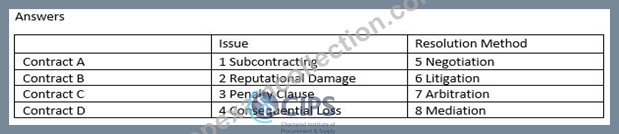
This is negotiation - no third party is mentioned and there is a face-to-face meeting in private
NEW QUESTION # 73
ABC has a contract with its supplier DEF who delivers pasta to ABC's manufacturing plant. DEF has committed a breach and conflict resolution has taken place. The Court has awarded ABC 'specific performance' damages. What could this involve?
- A. DEF must rescind the contract
- B. DEF must pay an amount of money as determined by the courts
- C. DEF must pay money to ABC as stated in the liquidated damages clause
- D. DEF must deliver the pasta required by ABC
Answer: D
Explanation:
DEF must deliver the pasta required by ABC is the correct answer. Specific performance is when the innocent party is rewarded by receiving what was initially negotiated - in this case the delivery of pasta. It's basically a posh way of saying that the court mandates you to do what the contract says. See p. 129 for information on Specific Performance.
NEW QUESTION # 74
Perry is seeking a resolution to a conflict he has with his supplier. He wants a third party to make a binding and legally enforceable decision and wants the issue to remain confidential. He is considering litigation. Is this the best solution for Perry?
- A. yes- litigation is the most appropriate for his requirements
- B. no- Perry should try Adjudication
- C. no- Perry should try mediation
- D. no - Perry should try Conciliation
Answer: B
Explanation:
Perry should try adjudication. Litigation is public so there would be no confidentiality. Out of the four options only adjudication would provide Perry with what he needs; a binding decision which is confidential. See p.146 for more information on litigation.
NEW QUESTION # 75
Which of the following will you put into box 6?
- A. liquidated damages
- B. liability
- C. Contract variation
- D. payment terms
Answer: A
Explanation:
The correct answers are as follows:
The answer is liquidated damages as they're seeking compensation for loss.
NEW QUESTION # 76
Dianne has a loan agreement which contains a clause for default. What does a clause for default imply?
- A. this allows the lender to demand overdue payments are made straight away
- B. this allows the lender to demand full payment of the outstanding balance
- C. this allows the lender to declare insolvency
- D. this allows a lender to demand payment from a guarantor if the borrower is unable to pay
Answer: B
Explanation:
A Clause for Default 'allows the lender to demand full payment of the outstanding balance'. See p.102. And always read the small print before you sign a loan agreement :)
NEW QUESTION # 77
Kranky Kat Ltd has just been through an adjudication process with a supplier it worked with who committed a breach in the contract. Kranky Kat is not happy with the outcome of the adjudication, what can Kranky Kat do?
- A. nothing - the decision made by the adjudicator is legally enforceable
- B. appeal the decision
- C. move on to litigation
- D. nothing - the decision made by the adjudicator is binding
Answer: B
Explanation:
If you're not happy with the decision of an adjudication you can appeal the decision. So option 2 is correct. If the appeal is turned down then unfortunately there's not much more you can do as adjudication is binding and legally enforceable. See p. 143 for more info on adjudication
NEW QUESTION # 78
Service Credits are a form of what?
- A. liquidated damages
- B. KPI
- C. indemnity
- D. Consideration
Answer: A
Explanation:
Service Credits are a form of Liquidated Damages - it's a financial remedy, common in the IT in-dustry, which is available to a buyer when the service level falls below an expected level. See p. 31 for more details.
NEW QUESTION # 79
What is the first stage in conflict resolution?
- A. look at remedies available
- B. identify the nature and source of the conflict
- C. decide on the type of conflict resolution approach
- D. assess the impact of the breach
Answer: B
Explanation:
The first stage is 'identify the nature and source of the conflict'. Stage 2 is assess the impact of the breach, stage 3 is look at remedies available and stage 4 is agree on a way forward and type of conflict resolution. These stages are explained on p.62 of the study guide.
NEW QUESTION # 80
Where two parties are engaged in international trade and have a long term relationship and a degree of mutual trust, which payment mechanism is commonly used?
- A. Letter of Credit
- B. Bill of Exchange
- C. Documentary Collection
- D. Stage Payment
Answer: C
Explanation:
Documentary collection is used in international transactions where there is trust. This is explained on p. 35 It's basically when supplier and buyer delegate collection of payments to their respective banks. They need to trust that each other will actually pay - otherwise they wouldn't delegate this. A Letter of Credit is a documentary credit confirmed by a bank, usually for export. A Bill of Ex-change is a promise to pay at a later date, usually supported by a bank. Stage payments are used in big purchases, such as construction projects where payment is given to the contractor when certain milestones are hit.
NEW QUESTION # 81
John is a chocolatier and has a big order of Easter Eggs coming up in April. He also creates chocolates to sell all year round in his shop, but Easter Eggs represent a large proportion of his profits each year. John's chocolate making machine has just broken and he has ordered a new one to be delivered in February. However due to a delay, the manufacturer of the new machine can't deliver until May. What course of action can John take?
- A. John can claim for loss of his regular earnings but not for the easter eggs
- B. John can claim for both the loss of the Easter Eggs and his regular earnings
- C. John cannot claim for any loss as these are in the future and he doesn't know what these would be
- D. John can claim for the loss of the Easter Eggs but not his regular earnings
Answer: B
Explanation:
3 is the correct answer. This question is testing your understanding of 'consequential loss' which is explained on p.109. Consequential loss is where you can claim damages for incidental loss (loss that isn't a direct cause of the breach of the contract, such as future earnings). In this scenario the breach is the late delivery and the incidental damage is John not being able to sell any chocolate in his shop or make his Easter Eggs. There are questions like this in the real exam- remember to think what the textbook would say and don't overthink this. The scenario doesn't always give you a lot of information (for example this doesn't say if there is a contract in place) so think- which of these four options is the most logical and what is this question trying to test me on.
NEW QUESTION # 82
A contract term which is difficult to classify at the time of drafting a contract is known as?
- A. warranty
- B. consideration
- C. innominate
- D. condition
Answer: C
Explanation:
Innominate - the conflict resolution process would determine if the clause is a condition or a war-ranty. Before there's a breach there's no way to know, so it's classed as an Innominate Term. P. 43. Types of contract terms comes up a lot in the exam. Learn these.
NEW QUESTION # 83
......
The CIPS L5M3 (Managing Contractual Risk) Certification Exam is designed to test the knowledge and skills of procurement professionals in managing contractual risks. This certification is particularly relevant for those who are involved in procurement activities that involve contracts, such as contract managers, procurement managers, and legal professionals. The exam covers a wide range of topics related to contract management, including contract formation, negotiation, risk assessment, and dispute resolution.
Actual Questions Answers Pass With Real L5M3 Exam Dumps: https://www.topexamcollection.com/L5M3-vce-collection.html
Pass Your Exam Easily! L5M3 Real Question Answers Updated: https://drive.google.com/open?id=1v2fXvQ61IfNTJtZKRuGHhjUVxgT87S5a
