

Pass SPLK-1002 Exam Latest Practice Questions Updated on Apr 06, 2026
Splunk SPLK-1002 Study Guide Archives
The SPLK-1002 Exam focuses on topics such as searching and analyzing data, creating dashboards and reports, and managing knowledge objects. Candidates will be tested on their ability to create complex search queries, use statistical commands, and create visualizations that effectively communicate data insights. Additionally, the exam covers topics such as field extraction, event types, and tags, which are essential for organizing and managing data in Splunk.
Splunk Core Certified Power User splk-1002 Exam
Splunk Core Certified Power User splk-1002 Exam is designed for individuals who has a basic understanding of SPL searching and reporting commands and can create knowledge objects, use field aliases and calculated fields, create tags and event types, use macros, create workflow actions and data models, and normalize data with the Common Information Model in either the Splunk Enterprise or Splunk Cloud platforms. This certification demonstrates an individual's foundational competence of Splunk's core software.
NEW QUESTION # 161
This clause is used to group the output of a stats command by a specific name.
- A. List
- B. By
- C. Rex
- D. As
Answer: D
NEW QUESTION # 162
Which statement is true?
- A. Data models are randomly structured datasets.
- B. Pivot is used for creating datasets.
- C. Pivot is used for creating reports and dashboards.
- D. In most cases, each Splunk user will create their own data model.
Answer: C
Explanation:
Explanation/Reference: https://docs.splunk.com/Documentation/Splunk/8.0.3/Pivot/IntroductiontoPivot
NEW QUESTION # 163
For choropleth maps,splunk ships with the following KMZ files (select all that apply)
- A. Countries of the European Union
- B. States and provinces of the united states and Canada
- C. States of the United States
- D. Countries of the World
Answer: C,D
Explanation:
Splunk ships with the following KMZ files for choropleth maps: States of the United States and Countries of the World. A KMZ file is a compressed file that contains a KML file and other resources. A KML file is an XML file that defines geographic features and their properties. A KMZ file can be used to create choropleth maps in Splunk by using the geom command. A choropleth map is a type of map that shows geographic regions with different colors based on some metric. Splunk ships with two KMZ files that define the geographic regions for choropleth maps:
States of the United States: This KMZ file defines the 50 states of the United States and their boundaries. The name of this KMZ file is us_states.kmz and it is located in the $SPLUNK_HOME/etc/apps/maps/appserver/static/geo directory.
Countries of the World: This KMZ file defines the countries of the world and their boundaries. The name of this KMZ file is world_countries.kmz and it is located in the $SPLUNK_HOME/etc/apps/maps/appserver/static/geo directory.
Splunk does not ship with KMZ files for States and provinces of the United States and Canada or Countries of the European Union. However, you can create your own KMZ files or download them from external sources and use them in Splunk.
NEW QUESTION # 164
When should the regular expression mode of Field Extractor (FX) be used? (select all that apply)
- A. For unstructured data.
- B. For data cleanly separated by a space, a comma, or a pipe character.
- C. For data in a CSV (comma-separated value) file.
- D. For data with multiple, different characters separating fields.
Answer: A,D
Explanation:
The regular expression mode of Field Extractor (FX) should be used for data with multiple, different
characters separating fields or for unstructured data. The regular expression mode allows you to select a
sample event and highlight the fields that you want to extract, and the field extractor generates a regular
expression that matches similar events and extracts the fields from them.ReferencesSee Build field extractions
with the field extractor - Splunk Documentation and Field Extractor: Select Method step - Splunk
Documentation.
NEW QUESTION # 165
In this search, __________ will appear on the y-axis. SEARCH: sourcetype=access_combined status!=200 | chart count over host
- A. status
- B. count
- C. host
Answer: B
Explanation:
In this search, count will appear on the y-axis2. This search uses the chart command to create a chart of the count of events over host for events that have status not equal to 2002. The chart command creates a table with one column for each value of the field after the over clause and one row for each value of the field after the by clause (if any)2. The values in the table are calculated by applying the function before the over clause to the events in each group2. In this case, the chart command creates a table with one column for each host and one row for the count of events for each host. The y-axis of the chart shows the values of the count function applied to each host. Therefore, option C is correct, while options A and B are incorrect because they appear on the x-axis or as labels of the chart.
NEW QUESTION # 166
Which of the following commands connects an additional table of data directly to the right side of the existing table?
- A. appendcols
- B. update
- C. append
- D. subsearch
Answer: A
Explanation:
The appendcols command in Splunk is used to connect an additional table of data directly to the right side of the existing table. It appends the results of a subsearch as new fields to the current results, effectively adding columns to the existing table.
NEW QUESTION # 167
During the validation step of the Field Extractor workflow:
Select your answer.
- A. You cannot modify the field extraction
- B. You can remove values that aren't a match for the field you want to define
- C. You can validate where the data originated from
Answer: B
Explanation:
During the validation step of the Field Extractor workflow, you can remove values that aren't a match for the field you want to define2. The validation step allows you to review and edit the values that have been extracted by the FX and make sure they are correct and consistent2. You can remove values that aren't a match by clicking on them and selecting Remove Value from the menu2. This will exclude them from your field extraction and update the regular expression accordingly2. Therefore, option A is correct, while options B and C are incorrect because they are not actions that you can perform during the validation step of the Field Extractor workflow.
NEW QUESTION # 168
A calculated field is a shortcut for performing repetitive, long, or complex transformations using which of the following commands?
- A. eval
- B. lookup
- C. transaction
- D. stats
Answer: A
Explanation:
Explanation
The correct answer is D. eval.
A calculated field is a field that is added to events at search time by using an eval expression. A calculated field can use the values of two or more fields that are already present in the events to perform calculations. A calculated field can be defined with Splunk Web or in the props.conf file. They can be used in searches, reports, dashboards, and data models like any other extracted field1.
A calculated field is a shortcut for performing repetitive, long, or complex transformations using the eval command. The eval command is used to create or modify fields by using expressions. The eval command can perform mathematical, string, date and time, comparison, logical, and other operations on fields or values2.
For example, if you want to create a new field named total that is the sum of two fields named price and tax, you can use the eval command as follows:
| eval total=price+tax
However, if you want to use this new field in multiple searches, reports, or dashboards, you can create a calculated field instead of writing the eval command every time. To create a calculated field with Splunk Web, you need to go to Settings > Fields > Calculated Fields and enter the name of the new field (total), the name of the sourcetype (sales), and the eval expression (price+tax). This will create a calculated field named total that will be added to all events with the sourcetype sales at search time. You can then use the total field like any other extracted field without writing the eval expression1.
The other options are not correct because they are not related to calculated fields. These options are:
A: transaction: This command is used to group events that share some common values into a single record, called a transaction. A transaction can span multiple events and multiple sources, and can be useful for correlating events that are related but not contiguous3.
B: lookup: This command is used to enrich events with additional fields from an external source, such as a CSV file or a database. A lookup can add fields to events based on the values of existing fields, such as host, source, sourcetype, or any other extracted field.
C: stats: This command is used to calculate summary statistics on the fields in the search results, such as count, sum, average, etc. It can be used to group and aggregate data by one or more fields.
References:
About calculated fields
eval command overview
transaction command overview
[lookup command overview]
[stats command overview]
NEW QUESTION # 169
Data model are composed of one or more of which of the fo-owing datasets? (select all that apply.)
- A. Search datasets
- B. Transaction datasets
- C. Any child of event, transaction, and search datasets
- D. Events datasets
Answer: A,B,D
NEW QUESTION # 170
Which of the following statements describe data model acceleration? (Choose all that apply.)
- A. Accelerated data models cannot be edited.
- B. Root events cannot be accelerated.
- C. You must have administrative permissions or the accelerate_datamodelcapability to accelerate a data model.
- D. Private data models cannot be accelerated.
Answer: A,C
NEW QUESTION # 171
Which of the following searches would return a report of salesby product_name?
- A. timechart list(sales), values(product_name)
- B. chart sales by product_name
- C. chart sum(price) as sales by product_name
- D. stats sum(price) as sales over product_name
Answer: D
Explanation:
Explanation/Reference: http://hilllaneconsulting.co.uk/blog/?p=640
NEW QUESTION # 172
Which of the following describes the Splunk Common Information Model (CIM) add-on?
- A. The CIM add-on contains dashboards that show how to map data.
- B. The CIM add-on is automatically installed in a Splunk environment.
- C. The CIM add-on contains data models to help you normalize data.
- D. The CIM add-on uses machine learning to normalize data.
Answer: C
Explanation:
The Splunk Common Information Model (CIM) add-on is a Splunk app that contains data models to help you normalize data from different sources and formats. The CIM add-on defines a common and consistent way of naming and categorizing fields and events in Splunk. This makes it easier to correlate and analyze data across different domains, such as network, security, web, etc. The CIM add-on does not use machine learning to normalize data, but rather relies on predefined field names and values. The CIM add-on does not contain dashboards that show how to map data, but rather provides documentation and examples on how to use the data models. The CIM add-on is not automatically installed in a Splunk environment, but rather needs to be downloaded and installed from Splunkbase.
NEW QUESTION # 173
Splunk alerts can be based on search that run______. (Select all that apply.)
- A. on a regular schedule
- B. in real-time
- C. and have no matching events
Answer: A,B
Explanation:
Explanation
Splunk alerts can be based on searches that run in real-time or on a regular schedule3. An alert is a way to monitor your data and get notified when certain conditions are met3. You can create an alert by specifying a search and a triggering condition3. You can also specify how often you want to run the search and how you want to receive the alert notifications3. You can run the alert search in real-time, which means that it continuously monitors your data as it streams into Splunk3. Alternatively, you can run the alert search on a regular schedule, which means that it runs at fixed intervals such as every hour or every day3. Therefore, options A and B are correct, while option C is incorrect because it is not a way to run an alert search.
NEW QUESTION # 174
Data models are composed of one or more of which of the following datasets? (select all that apply)
- A. Search datasets
- B. Transaction datasets
- C. Any child of event, transaction, and search datasets
- D. Events datasets
Answer: A,B,D
Explanation:
Data model datasets have a hierarchical relationship with each other, meaning they have parent-child relationships. Data models can contain multiple dataset hierarchies. There are three types of dataset hierarchies: event, search, and transaction.
https://docs.splunk.com/Splexicon:Datamodeldataset
NEW QUESTION # 175
The transaction command allows you to __________ events across multiple sources
- A. tag
- B. persist
- C. correlate
- D. duplicate
Answer: C
Explanation:
The transaction command allows you to correlate events across multiple sources. The transaction command is a search command that allows you to group events into transactions based on some common characteristics, such as fields, time, or both. A transaction is a group of events that share one or more fields that relate them to each other. A transaction can span across multiple sources or sourcetypes that have different formats or structures of data. The transaction command can help you correlate events across multiple sources by using the common fields as the basis for grouping. The transaction command can also create some additional fields for each transaction, such as duration, eventcount, startime, etc.
NEW QUESTION # 176
The timechart command is an example of which of the following command types?
- A. Orchestrating
- B. Transforming
- C. Statistical
- D. Generating
Answer: B
Explanation:
The correct answer is B. Transforming.
The explanation is as follows:
The timechart command is a Splunk command that creates a time series chart with corresponding table of statistics12.
A timechart is a statistical aggregation applied to a field to produce a chart, with time used as the X-axis1. You can specify a split-by field, where each distinct value of the split-by field becomes a series in the chart1.
Transforming commands are commands that change the format of the search results into a data structure that can be easily visualized3. Transforming commands often use stats functions to aggregate and summarize data3.
Therefore, the timechart command is an example of a transforming command, as it transforms the search results into a chart and a table using stats functions123.
NEW QUESTION # 177
Based on the macro definition shown below, what is the correct way to execute the macro in a search string?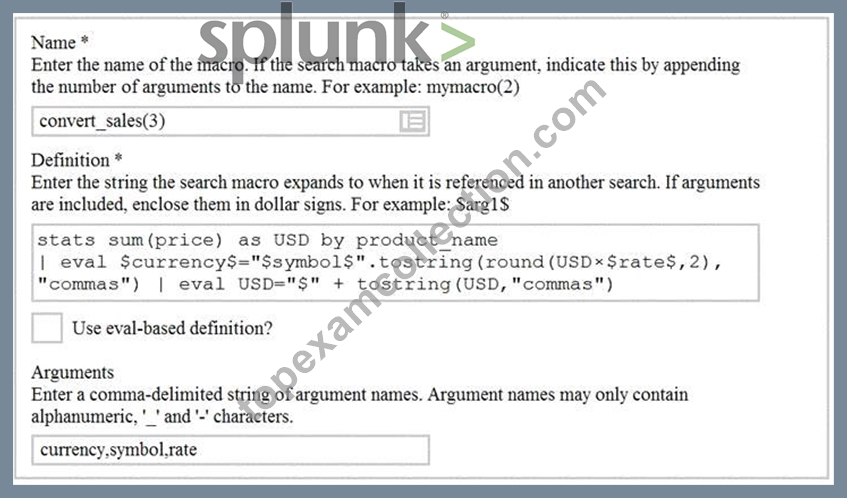
- A. Convert_sales (euro, €, 79)"
- B. Convert_sales ($euro,$€$,s79$
- C. Convert_sales (euro, €, .79)
- D. Convert_sales ($euro, $€$,S,79$)
Answer: C
Explanation:
Reference: https://docs.splunk.com/Documentation/Splunk/8.0.3/Knowledge/Usesearchmacros The correct way to execute the macro in a search string is to use the format macro_name($arg1$, $arg2$,
...) where $arg1$, $arg2$, etc. are the arguments for the macro. In this case, the macro name is convert_sales and it takes three arguments: currency, symbol, and rate. The arguments are enclosed in dollar signs and separated by commas. Therefore, the correct way to execute the macro is convert_sales($euro$, $€$,
.79).
NEW QUESTION # 178
A user wants to convert numeric field values to strings and also to sort on those values.
Which command should be used first, the eval or the sort?
- A. It doesn't matter whether eval or sort is used first.
- B. You cannot use the sort command and the eval command on the same field.
- C. Use sort first, then convert the numeric to a string with eval.
- D. Convert the numeric to a string with eval first, then sort.
Answer: C
Explanation:
Explanation
The eval command is used to create new fields or modify existing fields based on an expression2. The sort command is used to sort the results by one or more fields in ascending or descending order2. If you want to convert numeric field values to strings and also sort on those values, you should use the sort command first, then use the eval command to convert the values to strings2. This way, the sort command will use the original numeric values for sorting, rather than the converted string values which may not sort correctly. Therefore, option C is correct, while options A, B and D are incorrect.
NEW QUESTION # 179
How are arguments defined within the macro search string?
- A. 'arg'
- B. arg$
- C. "arg"
- D. %arg%
Answer: B
Explanation:
Arguments are defined within the macro search string by using dollar signs on either side of the argument
name, such as arg1 or fragment.
References
Search macro examples
Define search macros in Settings
Use search macros in searches
NEW QUESTION # 180
Which group of users would most likely use pivots?
- A. Users
- B. Architects
- C. Administrators
- D. Knowledge Managers
Answer: A
Explanation:
Reference:https://docs.splunk.com/Documentation/Splunk/8.0.3/Pivot/IntroductiontoPivot
A pivot is a tool that allows you to create reports and dashboards using data models without writing any SPL
commands2. You can use pivots to explore, filter, split and visualize your data using a graphical
interface2. Pivots are designed for users who want to analyze and report on their data without having to learn
the SPL syntax or the underlying structure of the data2. Therefore, option A is correct, while options B, C and
D are incorrect because they are not the typical group of users who would use pivots.
NEW QUESTION # 181
Which of the following search modes automatically returns all extracted fields in the fields sidebar?
- A. Smart
- B. C. Verbose
- C. Fast
Answer: B
NEW QUESTION # 182
Which of the following statements about event types is true? (select all that apply)
- A. Event types categorize events based on a search.
- B. Event types must include a time range,
- C. Event types can be tagged.
- D. Event types can be a useful method for capturing and sharing knowledge.
Answer: A,B
NEW QUESTION # 183
When using the timechart command, how can a user group the events into buckets based on time?
- A. Using the span argument.
- B. Adjusting the fieldformat options.
- C. Using the duration argument.
- D. Using the interval argument.
Answer: A
NEW QUESTION # 184
......
Splunk SPLK-1002 certification exam is a valuable credential for anyone looking to demonstrate their expertise in using Splunk software for data analysis and troubleshooting. It is a rigorous exam that tests candidates’ abilities to perform complex tasks and optimize deployments, making it a valuable asset for professionals in the IT industry.
SPLK-1002 Questions Prepare with Learning Information: https://www.topexamcollection.com/SPLK-1002-vce-collection.html
Download SPLK-1002 Mock Test Study Material: https://drive.google.com/open?id=17PviOqgPAF84o0KiPR_-vzQz-ooOLzJr
