

1z0-591 Free Certification Exam Easy to Download PDF Format 2025
Get 100% Success with Latest 11g 1z0-591 Exam Dumps
Oracle 1z0-591 certification exam is designed to test the knowledge and skills of IT professionals in the Oracle Business Intelligence Foundation Suite 11g Essentials. Oracle Business Intelligence Foundation Suite 11g Essentials certification is ideal for anyone who is looking to validate their knowledge in the field of business intelligence, and for those who are looking to advance their career in this field.
Oracle 1Z1-591 exam focuses on several aspects of Oracle Business Intelligence Foundation Suite 11g. These include architecture, security, installation, configuration, and reporting. A candidate is required to have complete knowledge of database connections, report creation, and dashboard customization to clear the exam successfully.
NEW QUESTION # 42
Selecting the Manage Map Data link allows one to do which three of the following?
- A. Import images for use on maps
- B. Associate map layers to columns defined in the OBIEE metadata
- C. Set the zoom level of an imported map
- D. Create a new map layer
Answer: A,B,C
Explanation:
Explanation/Reference:
The Oracle BI Presentation Services Administration page provides the Manage Map Data link. This link displays the Manage Map Data page, where you can manage the logical and display versions of the data from various physical data sources. This defines the layers that content designers use when creating map views. The data that is available for managing maps and data is stored in Oracle Database as part of MapViewer.
Using this page, you provide:
* (A) Logical names to prevent any existing BI column mappings and map analyses from breaking because of changes to the physical data or to the data source.
* Display names so that the geographic data is meaningful to end users.
Note: Administering Maps Using Administration Pages
For (C) -layers, see 3-7 below.
For (D) -import images, see 11-12 below.
To administer maps using Administration pages:
1. Sign in to Oracle Business Intelligence.
2. In the global header, click Administration.
3. Click the Manage Map Data link to display the Manage Map Data page.
4. Click the Layers tab.
5. Click the Import Layers button to display the Import Layers dialog.
6. In the dialog, select the connection and the layers that are needed for zooming and drilling. (This tab is not prepopulated by other selections on the Administration pages. You can use any layers or images with any map.)
Click OK when you have finished selecting layers that are appropriate for the subject area with which you are working.
7. Back on the Layers tab, select a layer, then click the Edit Layer button to display the Edit Layer dialog in which you associate layers with attribute columns so that you can display BI data in the map view.
Click OK when you have finished editing the layer.
You use this tab to associate layers with BI data. If you use the City column in multiple subject areas, then you must associate it with a layer for each subject area.
8. Click the Background Maps tab, then click the Import Background Maps button to display the Import Background Maps dialog.
9. In the dialog, select the connection and the main maps to use.
The connection that you select for the main map can be different from the connection for the layers or images.
Click OK when you have finished selecting main maps.
10.Back on the Background Maps tab, select a map, then click the Edit Background Map button to display the Edit Background Map dialog in which you name the map and specify the order of layers and their zoom levels.
Click OK when you have finished editing the map.
11.Optionally, click the Images tab, then click the Import Images button to display the Import Images dialog. You can import images if you plan to use them as a format on maps.
12.In the dialog, select the connection and the images to use.
Click OK when you have finished selecting images.
13.Click Back when you have finished working with the Administration page. Your changes are saved automatically.
Reference: Oracle Fusion Middleware System Administrator's Guide for Oracle Business Intelligence Enterprise Edition, Configuring Mapping and Spatial Information
NEW QUESTION # 43
How do you get the BI plug-in for MS Office?
- A. By downloading it from the BI Server
- B. By contacting the administrator
- C. By downloading it from the Database Server
- D. By downloading it from Microsoft Server
Answer: A
Explanation:
Explanation/Reference:
Download and installation of the client
The client install executable is available for download from the More Products menu in Oracle BI Interactive Dashboards and Oracle BI Answers.
See picture below.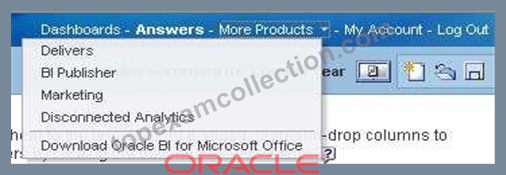
NEW QUESTION # 44
What is the process in which there is redundancy of data to improve performance?
- A. Denormalization
- B. Granularity
- C. Cardinality
- D. Redundancy
- E. Normalization
Answer: A
Explanation:
Denormalization is the process of intentionally backing away from normalization to improve performance by suppressing join and permitting the use of star transformation technique.
Denormalization should not be the first choice for improving performance and should only be used for fine tuning of a database for a particular application.
NEW QUESTION # 45
OBIEE default security model stores security Information such as user names and password combinations for accessing an external system such as Active Directory. It is stored in the____________.
- A. Policy Store
- B. Person Store
- C. Credential Store
- D. Identity Store
Answer: D
Explanation:
Identity Store: It is directory server to perform the authentication. It contains user name , password and groups membership information .When a user name and password combination is entered at log in, the authentication provider searches the identity store to verify the credentials provided. See figure below.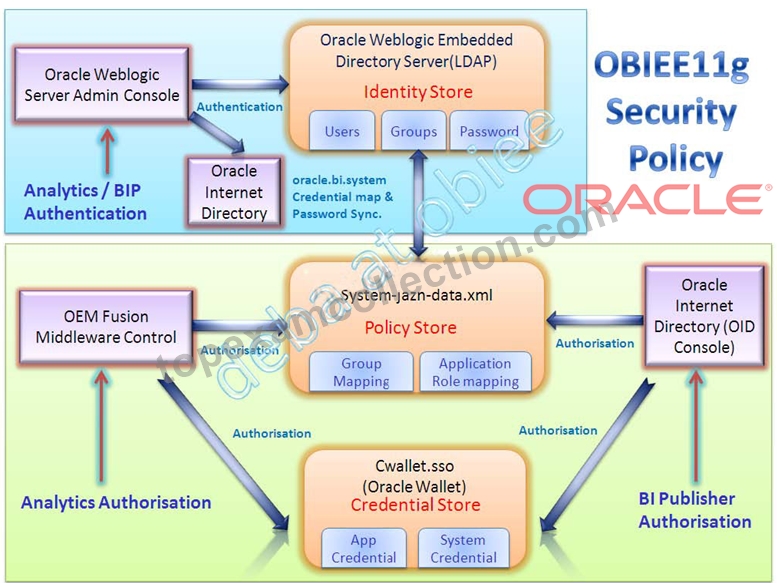
NEW QUESTION # 46
Which two options are valid Repository Variable names?
- A. USER
- B. Date
- C. CurrentMonth
- D. CurrentDay
Answer: C,D
Explanation:
CurrentDay and CurrentMonth can be calculated by a sql statement.
Note:
REPOSITORY VARIABLE(DYNAMIC)
* Initialized when BI server is started
* Assigned value dynamically based on the result of a query * Value is dependent of the sql provided in Initialization Block Create a dynamic variable and provide a Name and Default Initializer.Create a new initialization block by clicking on the New button in the above screen.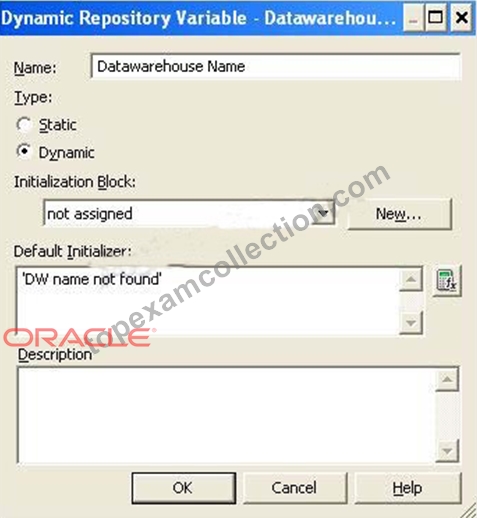
http://www.adivaconsulting.com/images/blog/OBIEE_Variable_files/image003.jpg
Provide Intialization Block variable Name
NEW QUESTION # 47
Select the scenario in which block storage must be used instead of aggregate storage.
- A. Millions of members in the outline
- B. Incremental data loading
- C. Top - down planning
- D. Extremely sparse data sets
Answer: C
Explanation:
Explanation/Reference:
BSO is preferred to ASO in the following scenarios:
* Top-down planning and allocation (Sales Forecasting)
* Cost Allocations across products and customers (Profitability Analysis)
* Currency conversion, inter-company eliminations(Financial consolidations) Incorrect answers:
A: Aggregate Storage: When loading data into an aggregate storage database, you can replace the contents of the database or the contents of all incremental data slices in the database.
C: Aggregate Storage: Architecture that supports rapid aggregation, optimized to support high dimensionality and sparse data
D: ASO cubes are designed to provide rapid aggregation capabilities for much larger Essbase outlines, typically supporting many more (and larger) dimensions.
Note: Aggregate storage databases enable dramatic improvements in both database aggregation time and dimensional scalability. The aggregate storage kernel is an alternative to the block storage kernel.
Aggregate storage databases typically address read-only, "rack and stack" applications that have large dimensionality, such as the following applications:
Customer analysis. Data is analyzed from any dimension, and there are potentially millions of customers.
Procurement analysis. Many products are tracked across many vendors.
Logistics analysis. Near real-time updates of product shipments are provided.
NEW QUESTION # 48
What must be done before you can run the Oracle Business Intelligence 11g Installer?
- A. Create required Oracle Business Intelligence schemas in a database
- B. Ensure system meets installation requirements for Fusing Middleware, Oracle Business Intelligence, AND Repository Creation Utility
- C. Install the WLS Admin Server
- D. Obtain BI installation media
- E. Select installation components - OBIEE, BIP, RTD
Answer: A,B,D
Explanation:
Before you can run Oracle Business Intelligence 11g Installer, you must first create required Oracle Business Intelligence schemas in an unhardened database. You use a tool called the Repository Creation Utility (RCU) to create these schemas with the appropriate permissions and data.
NEW QUESTION # 49
What are the two types of Repository Variables?
- A. Dynamic
- B. Non System
- C. Static
- D. System
Answer: A,C
Explanation:
There are static and dynamic repository variables.
Note:
Variables in the Oracle BI Server can be either repository or session variables, and are defined
using the Variable Manager within the Oracle BI Administrator (Manage > Variables).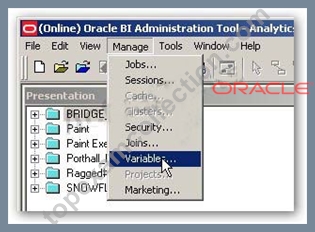
This brings up the Variable Manager, that divides variables out into repository and session variables, with a further subdivision into static and dynamic repository ones and system and non-system session ones. You can also define variables at the Presentation Server level, these are scoped to individual dashboards and are used amongst other things for setting dashboard prompt values and integrating the dashboard with BI Publisher parameters. Here's a screenshot of a typical Variable Manager screen.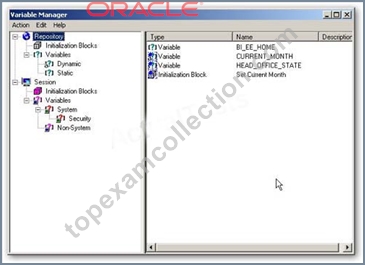
NEW QUESTION # 50
Which two Oracle BI Components contain security information regarding permissions and privileges?
- A. The Web Catalog
- B. InstanceConfig.xml File
- C. The Repository
- D. NQSConfig.ini File
- E. NQServer.ini File
Answer: A,C
Explanation:
Web Catalog does contain object permissions: folder, reports, etc. The repository has objects permissions to Subject Areas, etc.
Reference: Oracle Fusion Middleware System Administrator's Guide for Oracle Business, A NQSConfig.INI File Configuration Settings
NEW QUESTION # 51
If a customer is planning on building a data warehouse, how would you describe data warehousing to the customer?
- A. Application based data warehouses can be bought off the shelf and used without any tweaking.
- B. The data in the data warehouse describes events and statuses of business processes, products and services, goals and organizational units, and generally mirrors every aspect of the structure and behavior of the organization.
- C. Data warehouse projects are usually implemented within two weeks.
- D. Data warehouses can only be based on multidimensional data modeling.
Answer: B
Explanation:
Explanation
A data warehouse is a database used for reporting and data analysis. It is a central repository of data which is created by integrating data from multiple disparate sources. Data warehouses store current as well as historical data and are commonly used for creating trending reports for senior management reporting such as annual and quarterly comparisons.
NEW QUESTION # 52
The WebLogic Console will allow you to perform which of the following functions in the BI Managed Server?
- A. Start and Stop BI Services
- B. Manage user logins
- C. Build Aggregate Queries
- D. Create Summary Tables
Answer: A
Explanation:
Explanation
Explanation/Reference:
Screenshot below.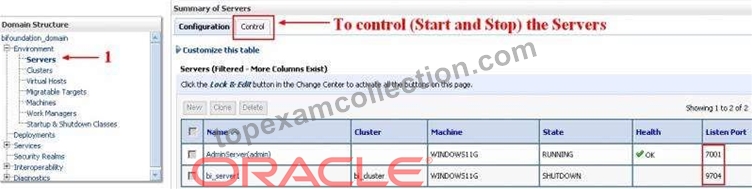
NEW QUESTION # 53
The Time Dimension hierarchy is a good example of a__________.
- A. Ragged Hierarchy
- B. Level-based Time Dimension hierarchy
- C. Skip Level Hierarchy
- D. Value-based Hierarchy
Answer: B
Explanation:
Explanation
Level-based Hierarchy
Level-based hierarchy is the first type of hierarchy in OBIEE.
Consists of an ordered set of two or more levels. For example, a Time hierarchy might have three levels for Year, Quarter, and Month. Level-based hierarchies can also contain parent-child relationships.
Dimension hierarchy levels allow :
* to perform aggregate navigation,
* to configure level-based measure calculations,
* users from Dashboard and Answers to drill down from one parent to a child level.
Special type of level-based dimension are supported:
* Unbalanced (or ragged) and Skip-level hierarchy
* time dimension to provides special functionality for modeling time series data.
NEW QUESTION # 54
A customer always wants Aggregate Table l to be looked at first to see if it can answer the query. What should be done to make sure this happens?
- A. Setthe Priority Croup to5.
- B. Make AggregateTable 1 the first table in the list ofLogical TableSources.
- C. Do not map the logical levelin the Content tab.
- D. Set the Priority Group to 0.
Answer: D
Explanation:
Priority group
You can set priority group numbers to determine which logical table source should be used for queries for which there is more than one logical table source that can satisfy the requested set of columns.
For example, you might have user queries that can be fulfilled by both a data warehouse and an OLTP source. Often, access to an operational system is "expensive," while access to a data warehouse is "cheap." In this situation, you can assign a higher priority to the data warehouse to ensure that all queries are fulfilled by the data warehouse if possible.
Note that the priority group of a given logical table source does not always ensure that a particular query will be fulfilled by that source.
Priority GroupDesignation 0the highest-priority source (the default) 1a lowest-priority source
NEW QUESTION # 55
What is the first step when creating an Aggregate table in the OBI repository?
- A. Test the Aggregate table by using Analysis
- B. Specify the Fact table that you want to aggregate
- C. Use Job Manager to run the Aggregate script
- D. Create a dedicated Connection Pool
Answer: B
Explanation:
Steps for Creating Aggregate Tables in OBIEE
1.Create all Dimension Tables, Fact Tables & Hierarchies, which are required to be aggregated.
2.Go to ToolsaUtilities (from Administration tool menu bar), a dialog box will pop up with all available utilities.
3.Select Aggregate Persistence Wizard, and then click Execute Button.
4.Now Select appropriate path where you need to generate Aggregate Table SQL.
Note : Click Generate DDL file for first time generation of Aggregate Table
Click Next, to move to next page (Select Business Model & Measure Page)
In Select Business Model & Measure Page, Select Appropriate Business Model & then select
associated Fact / Measure.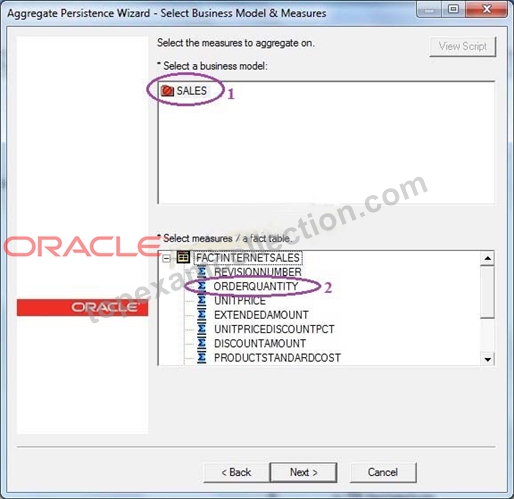
http://1.bp.blogspot.com/--vsF4VJcbss/T2H9xyA8HsI/AAAAAAAAAd4/JOFqD3KwgAE/s640/3.jpg Etc.
NEW QUESTION # 56
The administration tool is the developer's interface to the repository file. It allows the development of and changes to the metadata repository file. Which statement is true?
- A. Changes to the repository can only be carried out in offline mode.
- B. Multiple developers can work on one repository at the same time. Results can be merged later on.
- C. All aspects of security are being held in the repository file.
- D. Opening the rpd.file in online mode results in performance Issues for the application user.
Answer: B
Explanation:
The Oracle BI repository development process adheres to the classic Software Configuration Management (SCM)process, which utilizes a three-way merge to manage concurrent development.
The merge process involves three repositories:
* The (Original|Received|Master|Parent) repository. The repository that you received before changed.
You must keep it preciously unchanged.
* The Modified repository. The repository that contains the customizations you made to the original repository.
* The Current repository. Generally, the repository that is in production and where some customisations could have been performed by other people.
In a multiuser environment (MUDE), Developers check out the file and make changes locally. Then, these changes are automatically reconciled and merged into the master repository.
NEW QUESTION # 57
Which two Oracle BI Components contain security information regarding permissions and privileges?
- A. The Web Catalog
- B. InstanceConfig.xml File
- C. The Repository
- D. NQSConfig.ini File
- E. NQServer.ini File
Answer: A,C
Explanation:
Web Catalog does contain object permissions: folder, reports, etc. The repository has objects permissions to Subject Areas, etc.
NEW QUESTION # 58
How do Dynamic Repository Variables differ from Static Repository Variables?
- A. Dynamic Repository Variables cannot be used in a CASE statement.
- B. Dynamic Repository Variables are not initialized by the Initialization Block.
- C. Dynamic Repository Variables cannot be used in the Expression Builder.
- D. Dynamic Repository Variables can be changed by data that is returned from queries.
Answer: D
Explanation:
Explanation
Dynamic Repository Variables:
You initialize dynamic repository variables in the same way as static variables, but the values are refreshed by data returned from queries. When defining a dynamic repository variable, you will create an initialization block or use a pre-existing one that contains a SQL query. You will also set up a schedule that the Oracle BI Server will follow to execute the query and periodically refresh the value of the variable.
Note: The value of a static repository value is initialized in the Variable dialog box. This value persists, and does not change until an Oracle BI Administrator decides to change it.
NEW QUESTION # 59
Where is Cache in OBIEE located?
- A. In relational database
- B. It is local disk-based.
- C. In dynamic aggregate
- D. In memory cache
Answer: B
Explanation:
Explanation/Reference:
In OBIEE cache will be stored as files on the Hard Disk of the OBIEE Server in the form of files.
NEW QUESTION # 60
What are the two ways to use the administration tool?
- A. It can be used for versioning of the rpd.
- B. The administration tool uses a set of wizards that support the design of calculations, expressions, dimensions, and so on.
- C. It can be used to manage user password.
- D. Administrator can use repository and session variables in a repository to streamline administrative tasks and dynamically modify metadata content to adjust to a changing data environment.
Answer: A,D
Explanation:
Note: The Administration tool is used to manage OBIEE server and have some capabilities to automate some repetitive tasks and principally his embedded tools.
Oracle Business Intelligence Administration Tool is available only for Windows operating systems.
The Administration Tool is a Windows application that allows the BI Server administrator to create and edit repositories.
Repositories can be edited with the administration tool in either online or offline mode.
The Administration Tool also includes a session manager and a cache manager which are available in online mode. The Cache Manager displays what queries have been cached and how frequently they have been accessed. You can also select and delete items
NEW QUESTION # 61
Which two options are included in Oracle BI Server cache management techniques?
- A. Manage access to Subject Areas
- B. Scheduling Server password
- C. Maximum Number of Rows to Download to Excel
- D. Using NQSConfig.ini to manually edit the parameters
- E. Inspecting the cache reports
Answer: D,E
Explanation:
A: Much of the configuration of OBI that used to be done in the NQSConfig.ini files can now be done using this front end console, which in turns updates the NQSConfig.ini file. Things in the NQSConfig.ini file that are set by EM are noted in the file with '# This Configuration setting is managed by Oracle Business Intelligence Enterprise Manager'. Some things that needs to be setup manually in the NQSConfig.ini file are:
1. Usage Tracking
2. Dynamic Libraries
3. Query Optimization Flags
4. MDX Member Name Cache Section (SAP BW)
5. More specific General Settings where EM doesn't contain the level of detail required D: Cache Management Techniques include
* Inspecting the cache reports
* Configuring the cache parameters
* Setting caching and cache persistence for tables
* Using the Cache Manager
* Inspecting SQL for cache entries
* Modifying the Cache Manager column display
* Purging the cache entries manually using the Cache Manager
* Purging the cache entries automatically
* Using event polling tables
* Seeding the cache
NEW QUESTION # 62
......
Oracle Business Intelligence Foundation Suite offers a complete and integrated BI platform that enables organizations to make informed business decisions based on real-time data. This suite includes various tools and applications that can help users to access, analyze, and share information effectively. The Oracle 1Z1-591 exam tests the knowledge of candidates in these tools and applications, such as the Oracle BI Interactive Dashboards, Oracle BI Answers, and Oracle BI Delivers.
Get Ready to Pass the 1z0-591 exam Right Now Using Our 11g Exam Package: https://www.topexamcollection.com/1z0-591-vce-collection.html
The Best 1z0-591 Exam Study Material and Preparation Test Question Dumps: https://drive.google.com/open?id=1iOC9K8UqqS5Jupts8NMZuWD2imVmBmx9
